|
|
Last
Modified on
Jul 23, 2026
TEXTING AND DRIVING: EYES UP, PHONE DOWN
WHAT HAPPENS WHEN YOU TEXT AND DRIVE?
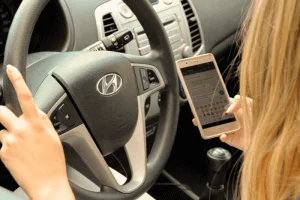
Every day on the roads, distracted drivers are looking at their cell phones. Whether texting, viewing social media, watching videos, or looking for directions, the dangers are real and deadly.
While distracted driving includes any activity that diverts your attention away from the road, including playing with the stereo or eating, the biggest distraction is our cell phones. Consider that reading or sending a text message will cause you to take your eyes off the road for five seconds on average. At a speed of 55 MPH, you would drive the equivalent of a football field with your eyes closed.
Text and drive statistics show that according to the National Highway Traffic Safety Administration (NHTSA), 3,208 people were killed in crashes involving distracted drivers in 2024, and hundreds of thousands more are injured in distracted driving crashes every year. The toll has stayed stubbornly high year after year.
TEXTING AND DRIVING LAW (IS IT LEGAL TO TEXT AND DRIVE?)
In 2021, law enforcement in Arizona became able to issue citations and fines to drivers violating Arizona’s distracted driving law. Arizona’s law bans the use of cell phones while driving (A.R.S. 28-914). The law forbids holding (or supporting with any part of your body – i.e., propping the phone up with a shoulder) a “portable wireless communication device.” Use of the portable device would include talking on the phone; writing, reading, or sending text-based messages (including instant messages and email); watching/recording videos, or scrolling social media. Under A.R.S. 28-914, distracted driving is a primary offense meaning an officer can pull over a driver if a driver is observed with a mobile device in their hand while driving.

The Arizona distracted driving law requires a fine of at least $75 (but no more than $149) for the first offense and at least $150 (but no more than $250) for the second and all subsequent violations.
If distracted driving results in a crash causing serious bodily injury or death, a driver can be charged with a Class 1 misdemeanor. (A.R.S. 28-672). Conviction of the misdemeanor could result in the suspension of the driver’s license for at least 90 to 180 days for serious injury and 180 days to one year for violations resulting in wrongful death. (A.R.S. 28-672)
It is too soon to tell whether citations and fines issued to drivers violating A.R.S. 28-914 have curbed the use of cell phones while driving or reduced crashes caused by distracted driving. It seems debatable as, anecdotally, every day we continue to see drivers talking on cell phones and looking at their phones while driving.
WHAT ARE SOME SOLUTIONS FOR TEXTING AND DRIVING?
When driving, consider using Bluetooth, hands-free options for your cell phone. If you must use your phone, consider the following safety tips:
- Pullover to a safe location and park before texting, making, or receiving a call.
- Consider having a passenger act as a designated texter or navigator to read maps and provide directions.
- Resist the temptation altogether by putting your phone in the glove box or trunk
FACTS
Sadly, the car accident lawyers at Bleaman Law Firm have seen an increase in crashes that appear to be caused by distracted driving. These crashes result in serious injuries to our clients while rarely, if ever, is the at-fault driver charged with the civil, distracted driving offense let alone criminal charges.
Many people think they are exempt from the risks of distracted driving. Too many think they can glance down for a moment and still maintain control of the car. The distracted driver rarely appreciates the serious risk to themselves, their passengers, and everyone else on the road.
Be safe, the text can wait. Drivers need to be aware of their surroundings and keep their attention on the road—not on their cell phones or other mobile devices. There is nothing important enough in that text message to risk ruining your life or someone’s else life. Drive now, text later!
Hit by a Distracted Driver in Arizona? Know Your Options
If a driver who was texting hurt you, the criminal ticket and your injury claim run on two separate tracks. The money for your medical bills, lost income, and pain comes from the civil claim, not from whatever fine the driver pays the court.
A Texting Citation Can Strengthen Your Claim
When the other driver is cited under A.R.S. 28-914, that violation is strong evidence they were negligent, because Arizona treats breaking a safety law as a failure to drive reasonably. It can move the fault question in your direction before negotiations even start. A ticket is not required, though. You can still prove distraction through other evidence, so a driver who talks their way out of a citation has not escaped responsibility.
How to Prove the Other Driver Was on Their Phone
Distraction is usually invisible after the fact, so it has to be built from evidence. The strongest pieces include:
- Cell phone records, which a lawyer can lock down with a preservation letter and pull through a subpoena to show call and text activity at the moment of impact.
- The police report, especially any note that the driver admitted to using a phone or seemed distracted.
- Witness accounts from passengers, other drivers, or bystanders who saw the phone in hand.
- Scene evidence such as traffic-camera footage, nearby business video, and the data stored by the vehicles themselves.
Carriers delete phone records on their own retention schedules, so the sooner someone demands them in writing, the better the chance they still exist when your claim needs them.
What You Can Recover
A distracted driving claim covers far more than the repair bill. Recoverable damages typically include medical treatment, future care, lost wages and lost earning capacity, and pain and suffering. Arizona also does not cap most personal injury damages under Article 2, Section 31 of its Constitution, so the value of a serious case tracks the real harm rather than an arbitrary ceiling. When injuries are lasting, the claim may reach beyond the at-fault driver’s minimum coverage to other available policies.
Deadlines and Fault in Arizona
You generally have two years from the crash to file a personal injury lawsuit under A.R.S. § 12-542. Arizona also follows pure comparative negligence under A.R.S. § 12-2505, so even if the insurer pins part of the blame on you, your compensation is reduced by your share of fault rather than wiped out. A distracted driver’s insurer will still hunt for reasons to pay less, which is why documenting the distraction early matters so much. The text that caused your crash was preventable, and so is a lowball settlement if you move while the evidence still exists.
Talk to a Tucson Car Accident Attorney About Your Distracted Driving Case
If a distracted driver hurt you or someone you love, you should not carry the medical bills and lost income while the person who was on their phone moves on. The Bleaman Law Firm, P.C. has spent years holding negligent drivers accountable and knows the tactics insurers use to shrink these claims.
Marc Bleaman defended insurance carriers before he started representing injured people, so he reads how the other side builds and values a distracted driving case. Contact our firm today or call (520) 323-1808 to talk through what happened and what your claim may be worth.
Arizona Distracted Driving Accident Resources: